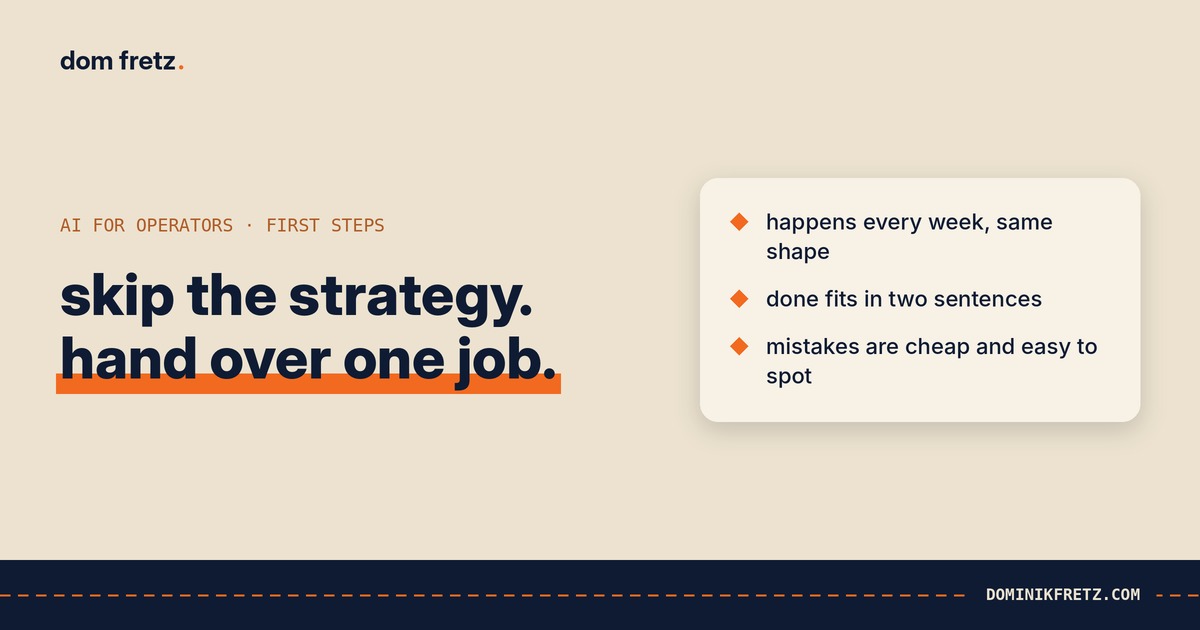
Most businesses don't need an AI strategy to get started.
They need one job off someone's desk.
The Same List, Every Time
Whenever I talk to operators, the same list comes up. The quotes. Chasing invoices. The customer email you write the same way every week. The Monday report someone rebuilds from scratch.
Most of these teams already pay for Claude or ChatGPT. Very few have it doing any of that work yet.
That gap isn't about capability. The tools can do these jobs. It's that nobody has picked one, handed it over properly and checked the result.
How I Pick the First One
Not every job is a good first job. I look for four things:
- It happens every week, in roughly the same shape. Repetition is what makes the effort worth it.
- You can describe "done" in two sentences. If you can't, the AI can't either.
- A mistake is cheap and easy to spot. Your first automation should not be the one that emails the wrong price to your biggest client.
- Someone on the team already hates doing it. That person becomes your best tester and your loudest advocate.
If a job ticks all four, start there. If nothing ticks all four, pick the one that ticks the most and make the mistakes cheaper.
Brief It Like a New Junior
The way you hand the job over matters more than which tool you use. I treat it the same way I'd brief a new junior on their first week.
- Write down what done looks like before anything starts. The format, the tone, what goes where, what never goes in.
- Run it on one small sample first. Check it properly. Then let it do the rest.
- Tell it to flag anything unclear instead of guessing. A good junior asks. So should your AI.
None of this is technical. It's the same delegation skill good managers already have. I've written more about this in the 5 levels of agentic development, where the jump from "chatting" to "delegating" is the one that changes everything.
Measure One Number
Pick one number and write it down before you start. How long did the job take before? How long does it take now?
That's it. No dashboard, no ROI model. One number you can say out loud in a team meeting.
No platform. No transformation program. One workflow, one baseline, one number.
Then It Snowballs
Once the first one works, the second one is easy. People have seen it work, the briefing habit is in place, and the next job is already on someone's mind.
By the third, the team starts bringing you ideas. That's when you need a strategy, and by then you'll have real evidence to build it on.
If you could hand one weekly job to AI tomorrow and trust it, which one would it be?
If you're curious what happens when this scales up, I wrote about it in You Didn't Get a Cost Reduction, You Got an Army. I share more of these on LinkedIn.