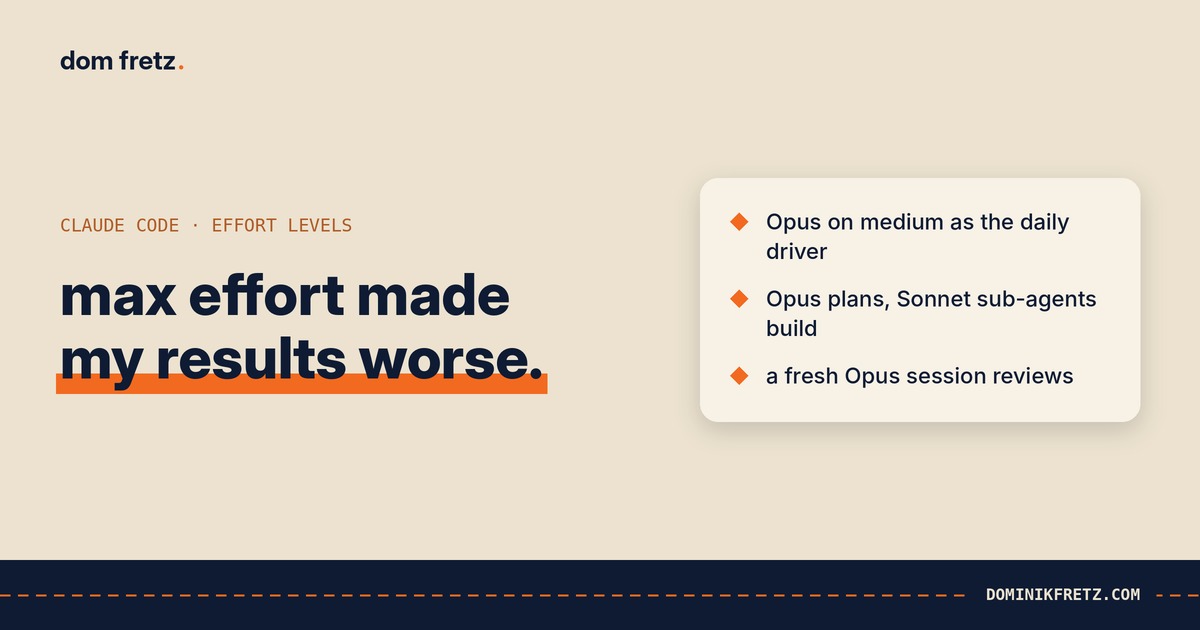
It seems obvious. Claude effort levels go from low up to max, so if you want better answers, you turn it up and let the model think harder.
So for a while I ran Claude on max effort for almost everything. More thinking, more tokens, better work. That was the theory.
In practice my results got worse, and my bill went up.
Why Max Effort Backfires
Max effort overthinks. On a simple task it goes looking for problems that aren't there, second-guesses a perfectly good first answer, and wanders off into edge cases nobody asked about.
It's also expensive. In my usage, max burns roughly 2.5 times the tokens of medium. High sits around 1.4 to 1.5 times. Those are my own rough numbers, not a benchmark, but the direction has been consistent.
And on most tasks, medium simply does the job better. So my daily driver is now Opus 5.5 on medium effort.
The Pattern I Use for Bigger Work
Medium handles the day to day. When something is genuinely big, I split the work across models instead of turning one dial up.
- Opus writes the plan and the spec. I only go to high effort if the problem is genuinely complex. Most of the time a clear spec matters more than extra thinking.
- Sonnet sub-agents do the implementation. They're cheaper, and with a clear spec they're more than capable.
- A fresh Opus sub-agent reviews the result. Not the thread that wrote the code. A model reviewing its own work is mostly a model agreeing with itself.
That last point is the one people skip. A new session has no memory of the shortcuts it took or the assumptions it made. It reads the work the way a colleague would, which is exactly what a review is for.
If you've read my post on PRD-driven development, you'll recognise the shape. The spec does the heavy lifting. The models just follow it.
Two Things That Catch People Out
Switching models throws away your cache. Opus and Sonnet don't share a cache, so jumping between them mid-conversation means paying to re-read everything. Switching effort level doesn't have that problem. If you want to change gear inside a session, change the effort, not the model.
You can set a default model per project. Put it in .claude/settings.json and you stop fiddling with it at the start of every session. One less decision before the work starts.
If You're on Pro
Don't overthink it.
If you're on a Pro plan and you're not hitting your limits, stay on Opus. The cost tricks above matter when you're running a lot of work or paying per token. If you're not, the simplest setup is the right one.
The Bigger Lesson
More effort isn't more quality. It's a setting, and like any setting it has a sweet spot.
The same goes for most of the knobs we reach for when results disappoint. More instructions, more tools, more thinking. Sometimes the fix is less. I wrote about the same pattern with instructions files in I Told Engineers to Delete Their CLAUDE.md.
What's your default setup? I'm curious how many people run max all day.
For more on how I structure agent work, see what agentic software engineering looks like in practice. I also share setups like this most weeks on LinkedIn.